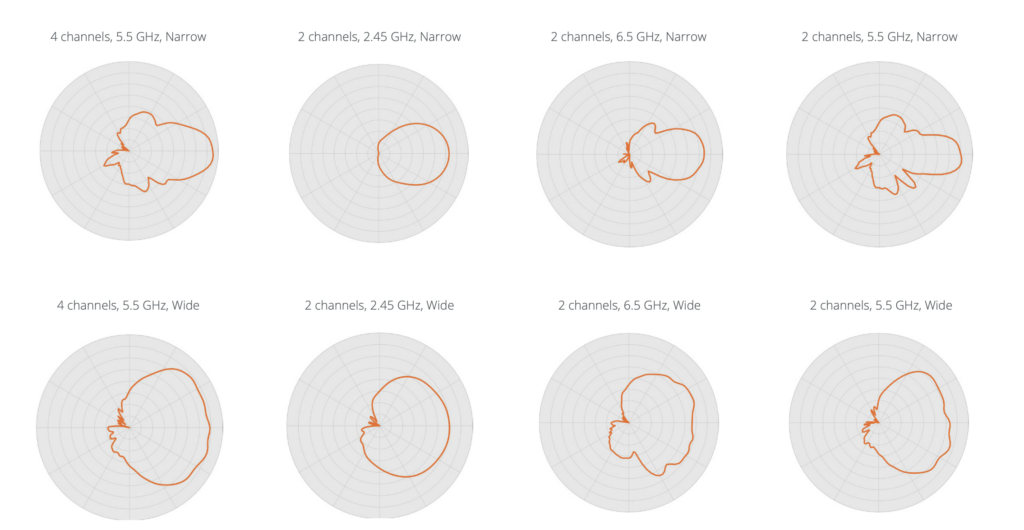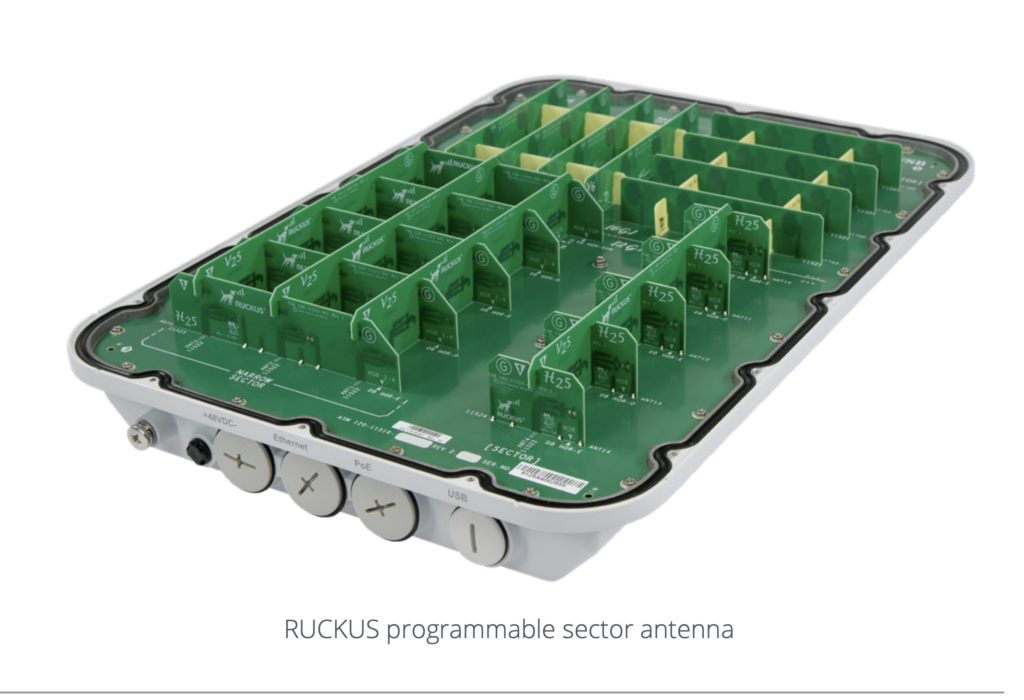

Ruckus’ newest outdoor AP has 12.8 dBi (narrow) and 11.3 dBi (wide) fixed sector antennas, selectable through software configuration. These APs are intended for large venues where the beam can be adjusted according to the needs of the event. The AP does not support the BeamFlex smart antenna system, but it does include Wi-Fi 7 with MLO and high-power transmission: 5 GHz 28 dBm (4x4 MIMO) and 6 GHz 35 dBm (2x2 MIMO).
The AP has one 5/2.5/1 Gbps Ethernet port and one 1 Gbps port, built-in GPS, and requires 802.3bt Power over Ethernet (with an optional 48V DC power input). The AP is manageable via SmartZone, R1, and Unleashed platforms.
Examples of radiation diagrams show radiation patterns for different frequencies: the higher the frequency, the better the antenna selectivity. This also means a better front-to-back ratio and the possibility of installing APs closer to each other. Ruckus’ radio solution is ultra-linear, radiating almost nothing into neighboring channels—by far the best we have seen in real spectrum analyzer tests. This makes it possible to design three-sector coverage areas on a single tower or mounting point.
Why is this design often not possible with competing products? All Wi-Fi devices use the CSMA/CA algorithm built into hardware. The AP must wait for the air to be clean before transmitting. The threshold for detecting a clean channel is −85 dBm, and this signal can come from any RF source—neighboring buildings or even mobile hotspots.